Polity Territory List
A viewset for viewing and editing Polity Territories.
GET /api/sc/polity-territories/?format=api&page=12
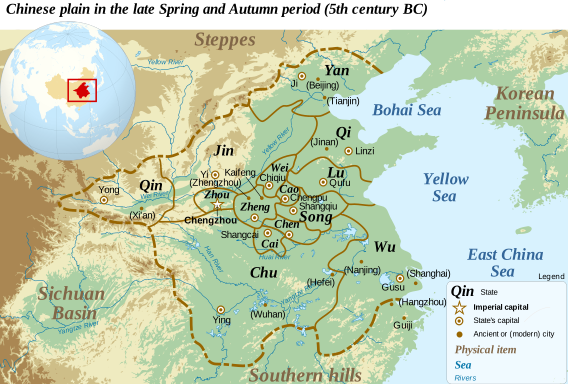
{ "count": 606, "next": "https://seshat-db.com/api/sc/polity-territories/?format=api&page=13", "previous": "https://seshat-db.com/api/sc/polity-territories/?format=api&page=11", "results": [ { "id": 937, "polity": { "id": 375, "name": "cn_viet_baiyu_k", "long_name": "Viet Baiyu Kingdom", "start_year": -332, "end_year": -109 }, "year_from": null, "year_to": null, "tag": "UND", "is_disputed": false, "is_uncertain": false, "name": "Polity_territory", "polity_territory_from": null, "polity_territory_to": null, "comment": null, "description": "in squared kilometers<br>Generic Baiyue reference: After 333 BCE to about 220 CE Yue also was used \"to refer to the 'barbarians' who lived to the south of the empire's territory in China's central plains region; a comparable term, Hu, referred to northerners.\"§REF§(West 2009, 81) Barbara A. West. 2009. Encyclopedia of the Peoples of Asia and Oceania. Facts On File. New York.§REF§<br>Generic Baiyue reference: \"By the late Warring States period, the term Baiyue had been applied to one time or another to the numerous indigenous tribes in Jiangsu, Zhejiang, Fujian, Jiangxi, Hunan, Guangxi and Guangdong.\"§REF§(To 1996, 71) Wing-Kai To. 1996. The Making of Cantonese Society in Late Imperial China: Religion, Community, and Identity Formation in the Pearl River Delta. University of California.§REF§<br>Nan Yue kingdom: \"The Pearl River delta, an area which remained remote and undeveloped, was part of the Nanyue (southern Yue) region associated with the Nanyue tribes who settled in Guangdong, Guangxi, and parts of Vietnam.\"§REF§(To 1996, 71) Wing-Kai To. 1996. The Making of Cantonese Society in Late Imperial China: Religion, Community, and Identity Formation in the Pearl River Delta. University of California.§REF§" }, { "id": 938, "polity": { "id": 240, "name": "ma_wattasid_dyn", "long_name": "Wattasid", "start_year": 1465, "end_year": 1554 }, "year_from": null, "year_to": null, "tag": "TRS", "is_disputed": false, "is_uncertain": false, "name": "Polity_territory", "polity_territory_from": 50000, "polity_territory_to": 60000, "comment": null, "description": "in squared kilometers<br>Difficult to estimate, according to Google area calculator the area of the core Wattasid Kingdom was about 50,000-60,000 km2.<br>https://en.wikipedia.org/wiki/Wattasid_dynasty#/media/File:Wattasids_-_Simplified_map.PNG<br>Map on page 105 \"Africa from the Sixteenth to the Eighteenth Century\"§REF§(Ogot ed. 1999, 105) Bethwell A Ogot. ed. 1999. General History of Africa. Abridged Edition. V. Africa from the Sixteenth to the Eighteenth Century. James Currey. UNESCO. California.§REF§ shows the core area is bordered by the Atlas mountains to the south, east and north. In the 16th and 17th centuries the core area shown is broadly similar to the Wikipedia map but a bit further south." }, { "id": 939, "polity": { "id": 247, "name": "cn_wu_confederacy", "long_name": "Wu Confederacy", "start_year": -585, "end_year": -477 }, "year_from": null, "year_to": null, "tag": "TRS", "is_disputed": false, "is_uncertain": false, "name": "Polity_territory", "polity_territory_from": 150000, "polity_territory_to": 150000, "comment": "in squared kilometers<br>This map (https://upload.wikimedia.org/wikipedia/commons/c/ca/Chinese_plain_5c._BC-en.svg), which may include maximum extent (conquest of Yue), would suggest about 150,000 km2.", "description": null }, { "id": 940, "polity": { "id": 291, "name": "cn_xixia", "long_name": "Xixia", "start_year": 1032, "end_year": 1227 }, "year_from": null, "year_to": null, "tag": "TRS", "is_disputed": false, "is_uncertain": false, "name": "Polity_territory", "polity_territory_from": 600000, "polity_territory_to": 650000, "comment": null, "description": "in squared kilometers<br>Very good map of Xixia on page 92 'The New Cultural Atlas Of China' which has an area of about 600,000-650,000 when plotted with Google maps area calculator.§REF§(? 2010, 91) ?. The Imperial Age. Tim Cooke. ed. 2010. The New Cultural Atlas Of China. Marshall Cavendish. New York.§REF§" }, { "id": 941, "polity": { "id": 248, "name": "cn_yue_dyn", "long_name": "Yue Kingdom", "start_year": -510, "end_year": -334 }, "year_from": null, "year_to": null, "tag": "TRS", "is_disputed": false, "is_uncertain": false, "name": "Polity_territory", "polity_territory_from": 80000, "polity_territory_to": 120000, "comment": null, "description": "in squared kilometers<br>\"Yue kingdom ... located in what is today northern Zhejiang and southern Anhui Provinces\".§REF§(West 2009, 81) Barbara A. West. 2009. Encyclopedia of the Peoples of Asia and Oceania. Facts On File. New York.§REF§<br>\"The territory of Yue was located in the northern part of the modern province of Zhejiang, in the southern parts of the Hangzhou Bay.\"§REF§Ulrich Theobald. 2000. ChinaKnowledge.de - An Encyclopaedia on Chinese History, Literature and Art. The Feudal State of Yue 越. <a rel=\"nofollow\" class=\"external free\" href=\"http://www.chinaknowledge.de/History/Zhou/rulers-yue.html\">http://www.chinaknowledge.de/History/Zhou/rulers-yue.html</a>§REF§" }, { "id": 942, "polity": { "id": 279, "name": "kz_yueban", "long_name": "Yueban", "start_year": 350, "end_year": 450 }, "year_from": null, "year_to": null, "tag": "UND", "is_disputed": false, "is_uncertain": false, "name": "Polity_territory", "polity_territory_from": null, "polity_territory_to": null, "comment": null, "description": "in squared kilometers<br>\"According to Chinese literary sources, by the fifth century the Yueban controlled the Ili River valley. The Yueban were part of northern Xiongnu, who inhabited in the upper Hi River during the fourth and fifth centuries.\"§REF§(Li and Hansen 2003, 63) Jian Li. Valerie Hansen. 2003. The glory of the silk road: art from ancient China. The Dayton Art Institute.§REF§<br>\"The Yueban were probably a tribe of the Northern Xiongnu and were formerly nomads north of Qiuci. They may be 'the Hu of Kuai' mentioned in the Jinshu, ch. 97. Later, the Yueban went north and occupied the former land of the Wusun i.e., the valleys of the Ili and Chu Rivers because the Wusun had suffered the invasion of the Rouran and migrated into the Cong Mountains. The Yueban whose population numbered two hundred thousand and whose territory stretched for several thousand li opposed the Rouran.\"§REF§(Yu 2004, 286). Taishan Yu. 2004. A history of the relationships between the western and eastern Han, Wei, Jin northern and southern dynasties and the western regions. University of Pennsylvania.§REF§" }, { "id": 943, "polity": { "id": 227, "name": "et_zagwe", "long_name": "Zagwe", "start_year": 1137, "end_year": 1269 }, "year_from": null, "year_to": null, "tag": "TRS", "is_disputed": false, "is_uncertain": false, "name": "Polity_territory", "polity_territory_from": 40000, "polity_territory_to": 50000, "comment": null, "description": "in squared kilometers<br>\"Map 7: The Zagwe period.\"§REF§(Bausi 2017, 109) Alessandro Bausi. The Zagwe. Siegbert Uhlig. David L Appleyard. Steven Kaplan. Alessandro Bausi. Wolfgang Hahn. eds. 2017. Ethiopia: History, Culture and Challenges. Michigan State University Press. East Lansing.§REF§ The shaded area is landlocked, bordered along the east by a mountain range, along the west by a river and ends in the north at about the modern Eritrean border. Approximates about 40,000-50,000 km2.<br>Not a large territory. Controlled the capital Adefa (Roha) and the towns/cities Lasta, Angot and Tigra \"and perhaps some part of Begemder.\"§REF§(Munro-Hay 2002, 23) Stuart Munro-Hay. 2002. Ethiopia, the Unknown Land: A Cultural and Historical Guide. I B Tauris. London.§REF§<br>Controlled highland regions of Eritrea, Amharaland, Bagemder and areas north of Lake Tana and northern Shewa.§REF§(Getahun and Kassu 2014, 9) Solomon Addis Getahun. Wudu Tafete Kassu. 2014. Culture and Customs of Ethiopia. ABC-CLIO. Santa Barbara.§REF§" }, { "id": 944, "polity": { "id": 222, "name": "tn_zirid_dyn", "long_name": "Zirids", "start_year": 973, "end_year": 1148 }, "year_from": null, "year_to": null, "tag": "TRS", "is_disputed": false, "is_uncertain": false, "name": "Polity_territory", "polity_territory_from": 500000, "polity_territory_to": 600000, "comment": "in squared kilometers<br>Map shows area covering modern Algeria excluding the western region (like Tlemcen) under the Hammadids, Libya excluding Cyrenaica, and Tunisia, an area of about 635,000 km2. Given a lot of this area is bare desert is it fair to say this map is an over-simplified exaggeration?<br>https://en.wikipedia.org/wiki/Zirid_dynasty#/media/File:Zirids_around_1000CE.png", "description": null }, { "id": 945, "polity": { "id": 586, "name": "gb_england_norman", "long_name": "Norman England", "start_year": 1066, "end_year": 1153 }, "year_from": null, "year_to": null, "tag": "TRS", "is_disputed": false, "is_uncertain": false, "name": "Polity_territory", "polity_territory_from": 135000, "polity_territory_to": 138000, "comment": "The approximate land area of modern England provides a baseline for Norman England, as the territorial boundaries were largely consistent. With Welsh Marches (maximum extent). <a class=\"fw-bold\" href=\"https://www.zotero.org/groups/1051264/seshat_databank/items/JISXN2HM\">[Carpenter 2003, pp. 125-162]</a>, <a class=\"fw-bold\" href=\"https://www.zotero.org/groups/1051264/seshat_databank/items/B7TUK4A3\">[Frere 1999]</a>", "description": "" }, { "id": 946, "polity": { "id": 798, "name": "de_east_francia", "long_name": "East Francia", "start_year": 842, "end_year": 919 }, "year_from": null, "year_to": null, "tag": "TRS", "is_disputed": false, "is_uncertain": false, "name": "Polity_territory", "polity_territory_from": 450000, "polity_territory_to": 500000, "comment": "East Francia was established by the Treaty of Verdun in 843, dividing the Carolingian Empire into three parts.\r\nEast Francia comprised territories that roughly correspond to modern-day Germany, Austria, parts of Switzerland, and small portions of neighboring regions like the Low Countries and France. <a class=\"fw-bold\" href=\"https://www.zotero.org/groups/1051264/seshat_databank/items/5FJNATV3\">[Costambeys_Innes_MacLean 2011]</a>", "description": "" }, { "id": 947, "polity": { "id": 177, "name": "tr_ottoman_emp_4", "long_name": "Ottoman Empire IV", "start_year": 1839, "end_year": 1922 }, "year_from": 1840, "year_to": 1840, "tag": "TRS", "is_disputed": false, "is_uncertain": false, "name": "Polity_territory", "polity_territory_from": 1448423, "polity_territory_to": 1448423, "comment": null, "description": "" }, { "id": 948, "polity": { "id": 587, "name": "gb_british_emp_1", "long_name": "British Empire I", "start_year": 1690, "end_year": 1849 }, "year_from": 1714, "year_to": 1750, "tag": "TRS", "is_disputed": false, "is_uncertain": false, "name": "Polity_territory", "polity_territory_from": 2000000, "polity_territory_to": 3900000, "comment": "1714: American colonies, Nova Scotia, Hudson.<br>\r\n\r\n1750:Advance in India, Canada <a class=\"fw-bold\" href=\"https://www.zotero.org/groups/1051264/seshat_databank/items/JZWVH8XI\">[Taagepera 1997]</a>", "description": "" }, { "id": 949, "polity": { "id": 587, "name": "gb_british_emp_1", "long_name": "British Empire I", "start_year": 1690, "end_year": 1849 }, "year_from": 1800, "year_to": 1837, "tag": "TRS", "is_disputed": false, "is_uncertain": false, "name": "Polity_territory", "polity_territory_from": 8000000, "polity_territory_to": 14000000, "comment": "1800: Half of India, Canada, Australia <br>\r\n\r\n1837: Most of Canada, Australia <a class=\"fw-bold\" href=\"https://www.zotero.org/groups/1051264/seshat_databank/items/JZWVH8XI\">[Taagepera 1997]</a>", "description": "" }, { "id": 950, "polity": { "id": 587, "name": "gb_british_emp_1", "long_name": "British Empire I", "start_year": 1690, "end_year": 1849 }, "year_from": 1837, "year_to": 1849, "tag": "TRS", "is_disputed": false, "is_uncertain": false, "name": "Polity_territory", "polity_territory_from": 14000000, "polity_territory_to": 23000000, "comment": "1850: All of Canada, Australia, India; most of Pakistan <a class=\"fw-bold\" href=\"https://www.zotero.org/groups/1051264/seshat_databank/items/JZWVH8XI\">[Taagepera 1997]</a>", "description": "" }, { "id": 951, "polity": { "id": 150, "name": "jp_sengoku_jidai", "long_name": "Warring States Japan", "start_year": 1467, "end_year": 1568 }, "year_from": null, "year_to": null, "tag": "TRS", "is_disputed": false, "is_uncertain": false, "name": "Polity_territory", "polity_territory_from": 300000, "polity_territory_to": 300000, "comment": "Combined territories controlled by factions would be around 70-80% of Japan's total area, with an area of approximately 300,000 square kilometers. <a class=\"fw-bold\" href=\"https://www.zotero.org/groups/1051264/seshat_databank/items/NJ9ZTY23\">[Cartwright 0]</a>", "description": "" }, { "id": 952, "polity": { "id": 465, "name": "uz_khwarasm_1", "long_name": "Ancient Khwarazm", "start_year": -1000, "end_year": -521 }, "year_from": null, "year_to": null, "tag": "UND", "is_disputed": false, "is_uncertain": false, "name": "Polity_territory", "polity_territory_from": null, "polity_territory_to": null, "comment": "in squared kilometers<br>\"German and Russian scholars have speculated on the existence before 500 BC of a 'Great Khwarazm Empire' extending from the Black Sea eastward to the Tian Shan and south to Herat in Afghanistan.\" <a class=\"fw-bold\" href=\"https://www.zotero.org/groups/1051264/seshat_databank/items/VDEDRURK\">[Starr 2013]</a> \"Briefly discussed in E. V. Rtveladaze, ed., Istoriia gosudarstevnnosti Uzbekistana, 3 vols. (Tashkent, 2009), 1:210.\" <a class=\"fw-bold\" href=\"https://www.zotero.org/groups/1051264/seshat_databank/items/VDEDRURK\">[Starr 2013]</a>", "description": null }, { "id": 953, "polity": { "id": 510, "name": "eg_badarian", "long_name": "Badarian", "start_year": -4400, "end_year": -3800 }, "year_from": null, "year_to": null, "tag": "UND", "is_disputed": false, "is_uncertain": false, "name": "Polity_territory", "polity_territory_from": null, "polity_territory_to": null, "comment": null, "description": "Badarian culture was first identified in the el-Badari region, near Sohag. But also, there was a large number of small sites near the villages of Qau el-Kebir, Hammamiya, Mostagedda, and Matmar§REF§Shaw, I. 2003. The Oxford History of Ancient Egypt. New York: Oxford University Press. Pg.36.§REF§. However, characteristic Badarian findings have also been located much further South, at Mahgar Dendera, Armant, Elkab, and Hierakonpolis, and also to the East, in the Wadi Hammamat§REF§Shaw, I. 2003. The Oxford History of Ancient Egypt. New York: Oxford University Press. Pg. 39.§REF§<br>Research on Badarian sites yielded a total of about 600 graves and forty poorly documented settlements. §REF§Shaw, I. 2003. The Oxford History of Ancient Egypt. New York: Oxford University Press. Pg. 36.§REF§ Were these settlements all one polity? Possibly. Analysis of Badarian grave goods demonstrates an unequal distribution of wealth and the wealthier graves tend to be separated in one part of the cemetery. This clearly indicates social stratification. §REF§Shaw, I. 2003. The Oxford History of Ancient Egypt. New York: Oxford University Press. Pg.37.§REF§" }, { "id": 954, "polity": { "id": 86, "name": "in_deccan_ia", "long_name": "Deccan - Iron Age", "start_year": -1200, "end_year": -300 }, "year_from": null, "year_to": null, "tag": "UND", "is_disputed": false, "is_uncertain": false, "name": "Polity_territory", "polity_territory_from": null, "polity_territory_to": null, "comment": "in squared kilometers. This is the combined area of the modern-day Indian states of Maharashtra, Karnataka, Andhra Pradesh, Kerala and Tamil Nadu, where \"the vast majority of prehistoric megaliths and associated sites are situated\" (though there are outliers in Jammu, Kashmir, Uttar Pradesh, Bihar, West Bengal, Rajasthan, Gujarat and Madhya Pradesh) <a class=\"fw-bold\" href=\"https://www.zotero.org/groups/1051264/seshat_databank/items/KTD23CBA\">[Brubaker 2001, pp. 253-302]</a>", "description": null }, { "id": 955, "polity": { "id": 502, "name": "ir_elam_8", "long_name": "Elam - Crisis Period", "start_year": -1100, "end_year": -900 }, "year_from": null, "year_to": null, "tag": "UND", "is_disputed": false, "is_uncertain": false, "name": "Polity_territory", "polity_territory_from": null, "polity_territory_to": null, "comment": "in squared kilometers. Unknown. The region was a quasi-polity with a variety of chieftains controlling small territories. No data has been found on the size of a typical polity.", "description": null }, { "id": 956, "polity": { "id": 497, "name": "ir_elam_3", "long_name": "Elam - Early Sukkalmah", "start_year": -1900, "end_year": -1701 }, "year_from": null, "year_to": null, "tag": "UND", "is_disputed": false, "is_uncertain": false, "name": "Polity_territory", "polity_territory_from": null, "polity_territory_to": null, "comment": "in squared kilometers<br>\"The prestige and influence of the sukkalmah during the early second millennium undoubtedly represent the apogee of Elamite political influence in Western Asia. Never before had Elamite political power been projected so far to the west, and it is unlikely that it had ever been projected equally far to the east.\" <a class=\"fw-bold\" href=\"https://www.zotero.org/groups/1051264/seshat_databank/items/G8C5RTGP\">[Potts 2016, p. 167]</a> \"The Shimashki dynasty of Elam was succceeded by a line of sukkal-mah. The latter controlled the whole of Elam from Susa to Anshan, including the mountainous regions in the north, shifting the political axis of Elam to the east.\" <a class=\"fw-bold\" href=\"https://www.zotero.org/groups/1051264/seshat_databank/items/67DQ6G7C\">[Liverani_Tabatabai 2014, pp. 195-196]</a>", "description": null }, { "id": 957, "polity": { "id": 498, "name": "ir_elam_4", "long_name": "Elam - Late Sukkalmah", "start_year": -1700, "end_year": -1500 }, "year_from": null, "year_to": null, "tag": "UND", "is_disputed": false, "is_uncertain": false, "name": "Polity_territory", "polity_territory_from": null, "polity_territory_to": null, "comment": "in squared kilometers<br>2nd millennium BCE: \"Some ninety settlements in the Susiana Plain scattered over an area of about 3,700 kilometers have been dated to the early historic periods. Six more of these sites have been identified in the 643 square kilometers of the Deh Luran Plain; seven more lie in the 217 square kilometers of the Ram Hormuz Plain. ... Sumner (1972) found about eighty early historic sites (phases V and VI) scattered over an area of about 1,500 square kilometers at elevations between 1,500 and 1,675 meters.\" <a class=\"fw-bold\" href=\"https://www.zotero.org/groups/1051264/seshat_databank/items/QE8XKMUX\">[Schacht_Hole 1987, p. 173]</a> \"The Shimashki dynasty of Elam was succceeded by a line of sukkal-mah. The latter controlled the whole of Elam from Susa to Anshan, including the mountainous regions in the north, shifting the political axis of Elam to the east.\" <a class=\"fw-bold\" href=\"https://www.zotero.org/groups/1051264/seshat_databank/items/67DQ6G7C\">[Liverani_Tabatabai 2014, pp. 195-196]</a>", "description": null }, { "id": 958, "polity": { "id": 496, "name": "ir_elam_2", "long_name": "Elam - Shimashki Period", "start_year": -2028, "end_year": -1940 }, "year_from": null, "year_to": null, "tag": "UND", "is_disputed": false, "is_uncertain": false, "name": "Polity_territory", "polity_territory_from": null, "polity_territory_to": null, "comment": "in squared kilometers<br>\"The historical phases at Susa ... - Old Akkadian, Ur III and Shimashki period - are not discernible at Anshan itself. Abandoned at the end of the Banesh period c.2600 BC, Tal-i Malyan was resettled c. 2200 BC, and the entire time span down to 1600 BC is characterized by a fairly uniform material culture referred to as 'Kaftari' (Sumner 1989).\" <a class=\"fw-bold\" href=\"https://www.zotero.org/groups/1051264/seshat_databank/items/G8C5RTGP\">[Potts 2016, p. 143]</a> \"In Elam, the princes of the new Shimashkian dynasty, who governed a vast area to the north and southeast of Susiana, drove out the Sumerians and gained control of Susa toward 2000 B.C.\" <a class=\"fw-bold\" href=\"https://www.zotero.org/groups/1051264/seshat_databank/items/MJBZDHTU\">[Louvre 1992, p. 8]</a>", "description": null }, { "id": 959, "polity": { "id": 503, "name": "ir_neo_elam_1", "long_name": "Elam I", "start_year": -900, "end_year": -744 }, "year_from": null, "year_to": null, "tag": "UND", "is_disputed": false, "is_uncertain": false, "name": "Polity_territory", "polity_territory_from": null, "polity_territory_to": null, "comment": null, "description": "in squared kilometers<br>\"When we next hear of Elam — in the annals of the Assyrian king Samsi-Adad V under the year 821 BC — the news is of a civil war waged inside a still existing big state, reaching 'from Bit Bunaki to Parsuas', i.e. apparently from a region south of Kirmanshah to Fars. Parsuas is here, as we shall attempt to show below, probably already a small kingdom inhabited by Iranian-speaking Persians. However, this is but a casual entry in the Assyrian annals; no other sources on Elam have come down to us from either the ninth or the greater part of the 8th century.\" §REF§(Diakonoff 1985, 18-19)§REF§" }, { "id": 960, "polity": { "id": 507, "name": "ir_elymais_2", "long_name": "Elymais II", "start_year": 25, "end_year": 215 }, "year_from": null, "year_to": null, "tag": "UND", "is_disputed": false, "is_uncertain": false, "name": "Polity_territory", "polity_territory_from": null, "polity_territory_to": null, "comment": "in squared kilometers<br>\"rural population densities climbed sharply during the Parthian era, particularly in the first two centuries A.D.\". <a class=\"fw-bold\" href=\"https://www.zotero.org/groups/1051264/seshat_databank/items/GAJ3UGPB\">[Wenke 1981, pp. 303-315]</a>", "description": null }, { "id": 961, "polity": { "id": 471, "name": "cn_hmong_2", "long_name": "Hmong - Early Chinese", "start_year": 1895, "end_year": 1941 }, "year_from": null, "year_to": null, "tag": "UND", "is_disputed": false, "is_uncertain": false, "name": "Polity_territory", "polity_territory_from": null, "polity_territory_to": null, "comment": null, "description": "in squared kilometers The Hmong inhabited several Chinese provinces: 'The various Miao groups are for the most part an unstratified agricultural people found in the uplands of several provinces of China and related to the Hmong of Southeast Asia. They are distinguished by language, dress, historical traditions, and cultural practice from neighboring ethnic groups and the dominant Han Chinese. They are not culturally homogeneous and the differences between local Miao cultures are often as great as between Miao and non-Miao neighbors. The term \"Miao\" is Chinese, and means \"weeds\" or \"sprouts.\" [The following figures refer to the present; comment by RA:] About half of China’s Miao are located in Guizhou Province. Another 34 percent are evenly divided between Yunnan Province and western Hunan Province. The remainder are mainly found in Sichuan and Guangxi, with a small number in Guangdong and Hainan. Some of the latter may have been resettled there during the Qing dynasty. The wide dispersion makes it difficult to generalize about ecological settings. Miao settlements are found anywhere from a few hundred meters above sea level to elevations of 1,400 meters or more. The largest number are uplands people, often living at elevations over 1,200 meters and located at some distance from urban centers or the lowlands and river valleys where the Han are concentrated. Often, these upland villages and hamlets are interspersed with those of other minorities such as Yao, Dong, Zhuang, Yi, Hui, and Bouyei.' §REF§Diamond, Norma: eHRAF Cultural Summary for the Miao§REF§ 'The Ch'uan Miao are an ethnic group living on the borders of Szechwan, Kweichow, and Yunnan Provinces, western China. The country is very mountainous with numerous peaks rising 3,000 to 6,000 feet above sea level. There are many streams, forests, waterfalls, perpendicular or overhanging cliffs, natural caves and natural bridges, and deepholes or pits where the water disappears into the bowels of the earth. While the roads between the Chinese towns and villages are generally paved with stones, most of the roads are narrow footpaths up and down the steep mountainsides or through fields and forests.' §REF§Graham, David Crockett 1954. “Songs And Stories Of The Ch’Uan Miao\", 1§REF§ Some authors claim periodic decreases in populaton size for the rural Hmong population and report inconsistencies in the self-reporting of settled territory: 'The area of the Sheng Miao, according to their exaggerated account, extends to 9,000 li, but actually the area is about 200 /sq./ li in length and width. It is a mountainous area, the highest peak at Teng-k'ung-ming-t'ang being 2,000 meters, and the total population about 10,000. The writer has visited altogether 101 Sheng Miao villages of all sizes, the largest being Chia-lu, Chia-mien, Chia-ya, Chia-lung, Chia-wêng, Cheng-yu, Tang-wêng and Chüeh-ts'ai-p'ing, with about 100 families in each. Even today they do not have a single market fair within the area and this shows how circumscribed is the sphere of their economic activity. Their only means of livelihood is agriculture. Almost all the fields are terraced according to natural topography, rising from the bottom of the slope to the top in several hundred layers. The shape of the field is long and narrow, producing rice, wheat, corn and barley. [...] Being in direct contact with them, the writer could watch at close quarters their extremely miserable conditions, which are pitiable indeed. Because of their ignorance they do not know how to save or to improve the method of production. In case of famine they cannot escape starvation, which is the most important reason for the decrease in their population.' §REF§Che-lin, Wu, Chen Kuo-chün, and Lien-en Tsao 1942. “Studies Of Miao-I Societies In Kweichow”, 73§REF§" }, { "id": 962, "polity": { "id": 153, "name": "id_iban_1", "long_name": "Iban - Pre-Brooke", "start_year": 1650, "end_year": 1841 }, "year_from": null, "year_to": null, "tag": "UND", "is_disputed": false, "is_uncertain": false, "name": "Polity_territory", "polity_territory_from": null, "polity_territory_to": null, "comment": "in squared kilometers Iban political organization was decentralized, with autonomous villages dominating the scene (see below). Reliable estimates of the territory typically covered by such a quasi-polity are very had to make. This is in part due to the practice of swidden cultivation and the persistence of uncultivated land in between inhabited communities. We therefore cannot provide a reliable proxy measure.", "description": null }, { "id": 963, "polity": { "id": 140, "name": "jp_jomon_3", "long_name": "Japan - Early Jomon", "start_year": -5300, "end_year": -3500 }, "year_from": null, "year_to": null, "tag": "UND", "is_disputed": false, "is_uncertain": false, "name": "Polity_territory", "polity_territory_from": null, "polity_territory_to": null, "comment": "in squared kilometers.<br>310,783 This is the sum of the following Jomon-occupied regions: Tohoku, Kanto, Hokoriku, Chubu, Kansai, Chugoku, Shikoku, Kyushu <a class=\"fw-bold\" href=\"https://www.zotero.org/groups/1051264/seshat_databank/items/F9RRA59H\">[Habu 2004, p. 48]</a>", "description": null }, { "id": 964, "polity": { "id": 143, "name": "jp_jomon_6", "long_name": "Japan - Final Jomon", "start_year": -1200, "end_year": -300 }, "year_from": null, "year_to": null, "tag": "UND", "is_disputed": false, "is_uncertain": false, "name": "Polity_territory", "polity_territory_from": null, "polity_territory_to": null, "comment": "in squared kilometers.<br>310,783<br>This is the sum of the following Jomon-occupied regions: Tohoku, Kanto, Hokoriku, Chubu, Kansai, Chugoku, Shikoku, Kyushu <a class=\"fw-bold\" href=\"https://www.zotero.org/groups/1051264/seshat_databank/items/F9RRA59H\">[Habu 2004, p. 48]</a>", "description": null }, { "id": 965, "polity": { "id": 139, "name": "jp_jomon_2", "long_name": "Japan - Initial Jomon", "start_year": -9200, "end_year": -5300 }, "year_from": null, "year_to": null, "tag": "UND", "is_disputed": false, "is_uncertain": false, "name": "Polity_territory", "polity_territory_from": null, "polity_territory_to": null, "comment": "in squared kilometers. 310,783 This is the sum of the following Jomon-occupied regions: Tohoku, Kanto, Hokoriku, Chubu, Kansai, Chugoku, Shikoku, Kyushu <a class=\"fw-bold\" href=\"https://www.zotero.org/groups/1051264/seshat_databank/items/F9RRA59H\">[Habu 2004, p. 48]</a>", "description": null }, { "id": 966, "polity": { "id": 142, "name": "jp_jomon_5", "long_name": "Japan - Late Jomon", "start_year": -2500, "end_year": -1200 }, "year_from": null, "year_to": null, "tag": "UND", "is_disputed": false, "is_uncertain": false, "name": "Polity_territory", "polity_territory_from": null, "polity_territory_to": null, "comment": "in squared kilometers.<br>310,783<br>This is the sum of the following Jomon-occupied regions: Tohoku, Kanto, Hokoriku, Chubu, Kansai, Chugoku, Shikoku, Kyushu <a class=\"fw-bold\" href=\"https://www.zotero.org/groups/1051264/seshat_databank/items/F9RRA59H\">[Habu 2004, p. 48]</a>", "description": null }, { "id": 967, "polity": { "id": 141, "name": "jp_jomon_4", "long_name": "Japan - Middle Jomon", "start_year": -3500, "end_year": -2500 }, "year_from": null, "year_to": null, "tag": "UND", "is_disputed": false, "is_uncertain": false, "name": "Polity_territory", "polity_territory_from": null, "polity_territory_to": null, "comment": "in squared kilometers.<br>310,783 This is the sum of the following Jomon-occupied regions: Tohoku, Kanto, Hokoriku, Chubu, Kansai, Chugoku, Shikoku, Kyushu <a class=\"fw-bold\" href=\"https://www.zotero.org/groups/1051264/seshat_databank/items/F9RRA59H\">[Habu 2004, p. 48]</a>", "description": null }, { "id": 968, "polity": { "id": 117, "name": "pk_kachi_enl", "long_name": "Kachi Plain - Aceramic Neolithic", "start_year": -7500, "end_year": -5500 }, "year_from": null, "year_to": null, "tag": "UND", "is_disputed": false, "is_uncertain": false, "name": "Polity_territory", "polity_territory_from": null, "polity_territory_to": null, "comment": null, "description": "in squared kilometers. Coded as not applicable: the living area is less than 1 km2 and the database in its current configuration does not accept decimal figures.<br>Mehrgarh overall is made up of 6 mounds, spread over an area of 500 acres. They were, however, not all occupied at the same time. §REF§Avari, Burjor, India: The Ancient Past: A History of the Indian Sub-Continent from C. 7000 BC to AD 1200 (London: Routledge, 2007),p.33§REF§. The total number of sites known is 33.§REF§Gregory L. Possehl. The Indus Civilization. A Contemporary Perspective. Walnut Creek, Altamira, 2002, p. 32§REF§ Mehrgarh I - II inter-regional styles of wheel-made pottery §REF§(Ahmed 2014, 322)§REF§: the living area grew from 2ha to 12 ha." }, { "id": 969, "polity": { "id": 118, "name": "pk_kachi_lnl", "long_name": "Kachi Plain - Ceramic Neolithic", "start_year": -5500, "end_year": -4000 }, "year_from": null, "year_to": null, "tag": "UND", "is_disputed": false, "is_uncertain": false, "name": "Polity_territory", "polity_territory_from": null, "polity_territory_to": null, "comment": null, "description": "in squared kilometers. Coded as not applicable: the living area is less than 1 km2 and the database in its current configuration does not accept decimal figures.<br>Mehrgarh overall is made up of 6 mounds, spread over an area of 500 acres. They were, however, not all occupied at the same time. §REF§Avari, Burjor, India: The Ancient Past: A History of the Indian Sub-Continent from C. 7000 BC to AD 1200 (London: Routledge, 2007),p.33§REF§. The total number of sites known is 33.§REF§Gregory L. Possehl. The Indus Civilization. A Contemporary Perspective. Walnut Creek, Altamira, 2002, p. 32§REF§ Mehrgarh I - II inter-regional styles of wheel-made pottery §REF§(Ahmed 2014, 322)§REF§: the living area grew from 2ha to 12 ha." }, { "id": 970, "polity": { "id": 123, "name": "pk_kachi_post_urban", "long_name": "Kachi Plain - Post-Urban Period", "start_year": -1800, "end_year": -1300 }, "year_from": null, "year_to": null, "tag": "UND", "is_disputed": false, "is_uncertain": false, "name": "Polity_territory", "polity_territory_from": null, "polity_territory_to": null, "comment": "squared kilometers.", "description": null }, { "id": 971, "polity": { "id": 124, "name": "pk_kachi_proto_historic", "long_name": "Kachi Plain - Proto-Historic Period", "start_year": -1300, "end_year": -500 }, "year_from": null, "year_to": null, "tag": "UND", "is_disputed": false, "is_uncertain": false, "name": "Polity_territory", "polity_territory_from": null, "polity_territory_to": null, "comment": "squared kilometers. It is seems very likely that Pirak was once part of a larger assemblage of culturally similar settlements, but, perhaps due to the erosive effects of nearby rivers, only Pirak remains <a class=\"fw-bold\" href=\"https://www.zotero.org/groups/1051264/seshat_databank/items/Q32UJUPX\">[Jarrige_Enault 1976, pp. 45-46]</a> Of course it's difficult to say whether these hypothetical settlements were part of the same polity as Pirak.", "description": null }, { "id": 972, "polity": { "id": 160, "name": "tr_konya_eba", "long_name": "Konya Plain - Early Bronze Age", "start_year": -3000, "end_year": -2000 }, "year_from": null, "year_to": null, "tag": "UND", "is_disputed": false, "is_uncertain": false, "name": "Polity_territory", "polity_territory_from": null, "polity_territory_to": null, "comment": "average size of polity within zone needed<br>Determining the geographic frontiers of Central Anatolia is also problematic. The frontiers are not only linked to climate and topography, but also to the location of sites. Pontic Mountains can be considered the South border, and similarly, the Taurus Mountains were in the South frontier. The Eastern boundary is the easiest to define: it is a straight line between modern Malatya and Trabzon. Western border is formed by crucial sites like Beycesultan, Demircihöyük, Karataş-Semayük . During Early Bronze Age, some Indo-European nations arrived on this land - this happened around 2300 BCE. Most of the Early Bronze Age II sites in Anatolia saw massive and violent destruction and these disasters brought an end to the EB II period.", "description": null }, { "id": 973, "polity": { "id": 158, "name": "tr_konya_eca", "long_name": "Konya Plain - Early Chalcolithic", "start_year": -6000, "end_year": -5500 }, "year_from": null, "year_to": null, "tag": "UND", "is_disputed": false, "is_uncertain": false, "name": "Polity_territory", "polity_territory_from": null, "polity_territory_to": null, "comment": null, "description": "KM2<br>The area includes Central Anatolia Plain (including Cappadocia with occasional references to Cilicia) and North-Central Anatolia within the bend of the Kızılırmak River.<br>\"The highest point of Western Çatalhöyük [the correct name should be: Çatalhöyük West- PF]; which was settled after people left the Neolithic Age settlement at the Eastern Çatalhöyük [the correct name should be: Çatalhöyük East- PF]; is 6 m above the level of the plain that is 1004 m above the sea level. Its diameter is approximately 300 m. The northwestern part of the mound is cut by a road; and the northeastern part by an old river bed replaced by a channel. Another reason why its dimensions cannot be exactly understood is that the mound is partly surrounded by alluvium like in Eastern Çatalhöyük. According to the researches; Western Çatalhöyük covers an area of 6.9 hectares. This is 8.5 hectares when the find distribution at the level of the alluvium is considered.\" §REF§<a rel=\"nofollow\" class=\"external free\" href=\"http://www.tayproject.org/TAYmaster.fm$Retrieve?YerlesmeNo=560&html=masterengdetail.html&layout=web\">http://www.tayproject.org/TAYmaster.fm$Retrieve?YerlesmeNo=560&html=masterengdetail.html&layout=web</a>§REF§<br>Çatalhöyük West: 8 ha; Canhasan I: 9ha; Yümüktepe/ Mersin: 12ha; Tepecik - Çiftlik: 6 ha; Köşk Höyük:4 ha§REF§Düring Bleda S., 2010. The prehistory of Asia Minor. From complex hunter-gatherers to early urban societies.,Cambridge University Press, p. 138-139§REF§§REF§Sharp Joukowsky Martha, 1996. Early Turkey Anatolian archaeology from prehistory through the Lydian Period., Kendall/Hunt Publishing Company USA, p. 108§REF§" }, { "id": 974, "polity": { "id": 157, "name": "tr_konya_lnl", "long_name": "Konya Plain - Late Neolithic", "start_year": -6600, "end_year": -6000 }, "year_from": null, "year_to": null, "tag": "UND", "is_disputed": false, "is_uncertain": false, "name": "Polity_territory", "polity_territory_from": null, "polity_territory_to": null, "comment": null, "description": "ET: 13 ha is 0.13 km2 Çatalhöyük: [130 000]; Tepecik-Çiftlik: uncoded; Pιnarbașι: uncoded; Can Hasan I: uncoded<br>For Çatalhöyük, settlement area of 13 ha was estimated as the maximum extent of occupied area dated to VI occupational phase. It is certain that after this period the extent of inhabited area started to decrease§REF§Düring B. 2007. Reconsidering the Çatalhöyük Community: From Households to Settlement Systems. Journal of Mediterranean Archaeology 20.2. pg. 156, 159.§REF§. For Tepecik-Çiftlik, there is only one value (over 700 m2) estimated for IV occupational level, but it is crucial to note that this is only a dimension of area exposed during excavations§REF§Bιçakçι E., Çakan Y.G., Godon M.. 2012. Pιnarbașι: Tepecik-Çiftlik[in]: Bașgelen N., P. Kuniholm, M. Özdoǧan (eds.) \"The Neolithic in Turkey: New Excavations and New Research\", Istanbul. pg. 93.§REF§." }, { "id": 975, "polity": { "id": 384, "name": "in_mahajanapada", "long_name": "Mahajanapada era", "start_year": -600, "end_year": -324 }, "year_from": null, "year_to": null, "tag": "UND", "is_disputed": false, "is_uncertain": false, "name": "Polity_territory", "polity_territory_from": null, "polity_territory_to": null, "comment": "squared kilometers.", "description": null }, { "id": 976, "polity": { "id": 532, "name": "mx_monte_alban_5", "long_name": "Monte Alban V", "start_year": 900, "end_year": 1520 }, "year_from": null, "year_to": null, "tag": "UND", "is_disputed": false, "is_uncertain": false, "name": "Polity_territory", "polity_territory_from": null, "polity_territory_to": null, "comment": "As the Zapotec state was in a process of fragmentation into smaller polities, the actual extent of any polity in the Valley of Oaxaca is very difficult to determine for this period. <a class=\"fw-bold\" href=\"https://www.zotero.org/groups/1051264/seshat_databank/items/SHF4S8D7\">[Flannery_Marcus 1996]</a> \"Table 10.1. Population of Late Postclassic polities in the Central Valleys of Oaxaca\" + \"Table 10.2. Population of other Late Postclassic polities in highland Oaxaca.\" = ~ 61 polities. <a class=\"fw-bold\" href=\"https://www.zotero.org/groups/1051264/seshat_databank/items/2SPGQ7I8\">[Feinman_Nicholas 2013, pp. 158-159]</a> Polity territory = total area / 61?", "description": null }, { "id": 977, "polity": { "id": 435, "name": "co_neguanje", "long_name": "Neguanje", "start_year": 250, "end_year": 1050 }, "year_from": null, "year_to": null, "tag": "UND", "is_disputed": false, "is_uncertain": false, "name": "Polity_territory", "polity_territory_from": null, "polity_territory_to": null, "comment": "in squared kilometersThe Neguanje population seems to have occupied the coast between the Cienaga (Marsh) and the mouth of the river Palomino.\"Parece que hacia los inicios de nuestra Era. una nueva población, denominada en la terminologla de Bischof (1983) como Neguanje, ocupó los alrededores de Ciénaga y dió comienzo a la ocupación del resto del Litoral hasta dominar toda la franja costanera comprendida entre Ciénaga y la desembocadura del Río Palomino en limites con la Guajira (Bischof, 1983); Wynn, 1975 Oyuela, 1985 y Langebaek, 1987).\" <a class=\"fw-bold\" href=\"https://www.zotero.org/groups/1051264/seshat_databank/items/HCBFKRJZ\">[Rueda 1987, p. 61]</a>", "description": null }, { "id": 978, "polity": { "id": 368, "name": "ye_rasulid_dyn", "long_name": "Rasulid Dynasty", "start_year": 1229, "end_year": 1453 }, "year_from": null, "year_to": null, "tag": "UND", "is_disputed": false, "is_uncertain": false, "name": "Polity_territory", "polity_territory_from": null, "polity_territory_to": null, "comment": "in squared kilometers<br>Ruled over \"the greater proportion of Yemeni territory for well over two centuries.\" <a class=\"fw-bold\" href=\"https://www.zotero.org/groups/1051264/seshat_databank/items/GIDWD7R3\">[Stookey 1978, p. 108]</a> \"the Rasulids managed to keep the Sultanate in a direct line for eight generations, although in their second century their territories started to shrink.\" <a class=\"fw-bold\" href=\"https://www.zotero.org/groups/1051264/seshat_databank/items/WR5RMRMQ\">[Bidwell 1983, p. 14]</a>", "description": null }, { "id": 979, "polity": { "id": 194, "name": "ru_sakha_early", "long_name": "Sakha - Early", "start_year": 1400, "end_year": 1632 }, "year_from": null, "year_to": null, "tag": "UND", "is_disputed": false, "is_uncertain": false, "name": "Polity_territory", "polity_territory_from": null, "polity_territory_to": null, "comment": null, "description": "in squared kilometers. Russian-era Sakha province covered a territory of considerable size: 'Sakha, also called Yakutiya or Yakut-Sakha, Yakutiya also spelled Yakutia, Udachnaya: diamond mine republic in far northeastern Russia, in northeastern Siberia. The republic occupies the basins of the great rivers flowing to the Arctic Ocean-the Lena, Yana, Indigirka, and Kolyma-and includes the New Siberian Islands between the Laptev and East Siberian seas. Sakha was created an autonomous republic of the Soviet Union in 1922; it is now the largest republic in Russia.' §REF§<a rel=\"nofollow\" class=\"external free\" href=\"http://www.britannica.com/place/Sakha-republic-Russia\">http://www.britannica.com/place/Sakha-republic-Russia</a>§REF§ 'Area 1,198,200 square miles (3,103,200 square km).' §REF§<a rel=\"nofollow\" class=\"external free\" href=\"http://www.britannica.com/place/Sakha-republic-Russia\">http://www.britannica.com/place/Sakha-republic-Russia</a>§REF§ The territorial distribution of administrative districts was subject to some variation: 'Yakutsk Province was formerly divided into five districts: Olekminsk, Yakutsk, Viliuisk, Verkhoyansk, and Kolymsk.' §REF§Jochelson, Waldemar 1933. “Yakut”, 65§REF§ But prior to Russian rule, the Sakha and other Siberian peoples employed a decentralized clan system. Furthermore, they were pastoralists. This makes the identification of the territory of a 'typical' quasi-polity more difficult." }, { "id": 980, "polity": { "id": 195, "name": "ru_sakha_late", "long_name": "Sakha - Late", "start_year": 1632, "end_year": 1900 }, "year_from": null, "year_to": null, "tag": "UND", "is_disputed": false, "is_uncertain": false, "name": "Polity_territory", "polity_territory_from": null, "polity_territory_to": null, "comment": null, "description": "in squared kilometers. Yakutsk province covered a territory of considerable size: 'Sakha, also called Yakutiya or Yakut-Sakha, Yakutiya also spelled Yakutia, Udachnaya: diamond mine republic in far northeastern Russia, in northeastern Siberia. The republic occupies the basins of the great rivers flowing to the Arctic Ocean-the Lena, Yana, Indigirka, and Kolyma-and includes the New Siberian Islands between the Laptev and East Siberian seas. Sakha was created an autonomous republic of the Soviet Union in 1922; it is now the largest republic in Russia.' §REF§<a rel=\"nofollow\" class=\"external free\" href=\"http://www.britannica.com/place/Sakha-republic-Russia\">http://www.britannica.com/place/Sakha-republic-Russia</a>§REF§ 'Area 1,198,200 square miles (3,103,200 square km).' §REF§<a rel=\"nofollow\" class=\"external free\" href=\"http://www.britannica.com/place/Sakha-republic-Russia\">http://www.britannica.com/place/Sakha-republic-Russia</a>§REF§ The territorial distribution of administrative districts was subject to some variation: 'Yakutsk Province was formerly divided into five districts: Olekminsk, Yakutsk, Viliuisk, Verkhoyansk, and Kolymsk.' §REF§Jochelson, Waldemar 1933. “Yakut”, 65§REF§ 'No less significant changes occurred in the administrative organization of the Yakut country. In the seventeenth century Yakutsk was the center of a great independent country directly subordinate to Moscow, although for some specific questions it was dependent on the governors of Tobolsk. In the time of Peter the Great, Yakutsk entered into the newly organized Siberian Goubernyia (government) and with the division of the Siberian government into provinces was included in Irkutsk Province. In 1775 Irkutsk Province was organized into a government and the Yakut country formed one of the provinces of the new government. In 1783 the government was again reorganized into a vice-royalty composed of four provinces, one of which was Yakutsk Province. In 1797 the vice-royalty was abolished and the government restored. In [Page 225] 1805 under the Emperor Alexander I, the Yakut country was made a separate province dependent upon Irkutsk. In 1852 the Yakut country was given a separate governor. After the revolution in February, 1917, a commissar was appointed by the Provisional Government.' §REF§Jochelson, Waldemar 1933. “Yakut”, 224§REF§ This regional integration was an artefact of Russian imperial rule. The decentralized political organization of the Sakha themselves makes the identification of a reliable and realistic code more difficult." }, { "id": 981, "polity": { "id": 439, "name": "mn_shiwei", "long_name": "Shiwei", "start_year": 600, "end_year": 1000 }, "year_from": null, "year_to": null, "tag": "UND", "is_disputed": false, "is_uncertain": false, "name": "Polity_territory", "polity_territory_from": null, "polity_territory_to": null, "comment": "in squared kilometers<br>\"Therefore the scope of the Shiwei's territory in the period from the Northern Qi to Sui can be approximated, it reached the Huolin River to the south, the Erguna River to the west, the Nenjiang River to the east, and the lower reaches of the Erguna River to the north. In the Tang period, it is known that there were twenty Shiwei tribes, according to the records in dynastic histories. They were the Wusugu, Yisaimo, Saiezhi, Hejie, Wuluohu, Nali, Lingxi, Shanbei, Huangtou, Da Ruzhe, Xiao Ruzhe, Powo, Nebeizhi, Luotuo, Dong Shiwei, Xi Shiwei, Da Shiwei, Mengwu Shiwei, Luozu Shiwei and Dagui.\" <a class=\"fw-bold\" href=\"https://www.zotero.org/groups/1051264/seshat_databank/items/RDUCXDAG\">[Xu 2005, p. 174]</a> \"Summing up the above discussion, the four boundaries of all the Shiwei tribes in the Tang Dynasty can be approximately described by the following: the eastern boundary was the modern Jingqili River; the western was the west of the modern Lake Hulun; the northern was the modern Sea of Okhotsk; and the southern was the south of the modern Huoli River.\" <a class=\"fw-bold\" href=\"https://www.zotero.org/groups/1051264/seshat_databank/items/RDUCXDAG\">[Xu 2005, p. 175]</a>", "description": null }, { "id": 982, "polity": { "id": 197, "name": "ec_shuar_2", "long_name": "Shuar - Ecuadorian", "start_year": 1831, "end_year": 1931 }, "year_from": null, "year_to": null, "tag": "UND", "is_disputed": false, "is_uncertain": false, "name": "Polity_territory", "polity_territory_from": null, "polity_territory_to": null, "comment": null, "description": "in squared kilometers Brüning and Karsten describe the territory, but fail to indicate its total size: 'The Indians are inhabitants of a region which extends along the upper course of the Marañón River, from Yusamaro downward to Puerto Meléndez at the Pongo de Manseriche. They live in this region in small and widely dispersed settlements close to the banks of the River. I have been informed that their chief settlements are located farther up along the tributary rivers. Beyond Yusamaro no Indians are said to remain anymore, yet formerly their settlements are said to have extended to the Pongo Rentema. They had moved down to the Marañón River on account of the quarrels they had with the whites or, rather, the mestizos. Their settlements can not be called permanent anyway. Despite the fact that the Indians live at one place for a long time, and in relatively permanent dwellings at that, they are said to leave their settlements frequently for no special reason in order to reestablish themselves again at some distance from the former settlement.' §REF§Brüning, Hans H. 1928. “Travelling In The Aguaruna Region”, 46§REF§ '“In describing my journeys among the Jibaro Indians I had occasion to mention repeatedly that the savage Jibaros never settle on the banks of the main rivers, but prefer to make their houses beside small affluents in the interior of the country. The reason for this is obvious: it is due to their constant fear of hostile attacks. By hiding themselves in the forests in the way they do, they not only avoid the whites, who now and then travel along the main rivers, but they are also better protected against hostile Indian tribes. The Jibaro houses are also largely constructed with a view to keeping off uninvited guests; in fact, nearly every house is a sort of fortress, as will be shown in greater detail in the part dealing with the warfare of the Indians.”' §REF§Karsten, Rafael 1935. “Head-Hunters Of Western Amazonas: The Life And Culture Of The Jibaro Indians Of Eastern Ecuador And Peru”, 94§REF§ Also, Shuar political organization was fluid and decentralized. We therefore cannot confidently provide realiable proxy measures for a 'typical' quasi-polity." }, { "id": 983, "polity": { "id": 493, "name": "ir_susa_2", "long_name": "Susa II", "start_year": -3800, "end_year": -3100 }, "year_from": null, "year_to": null, "tag": "UND", "is_disputed": false, "is_uncertain": false, "name": "Polity_territory", "polity_territory_from": null, "polity_territory_to": null, "comment": "in squared kilometers<br>\"It is possible then that the Middle Uruk settlements on the Susiana located more than about 20 kilometers from a major administrative center were only marginally articulated with a central Susiana-administered settlement system. This would have placed the boundaries of an integrated settlement system including the major centers of Susa, Abu Fanduweh, and Chogha Mish within the Susiana rather than, as I have often assumed, between the Susiana and adajacent areas.\" <a class=\"fw-bold\" href=\"https://www.zotero.org/groups/1051264/seshat_databank/items/VDM75LLF\">[Hole 1987, p. 116]</a> what does author mean by \"within the Susiana?\" - Susiana Plain?<br>Godin Tepe and Tepe Sialk in the west<br> \"like the early Sumerians, the Susians in this period became colonizers. They spread out along routes that led them to Godin Tepe and Tepe Sialk in west central Iran, organizing a trade network in which the agricultural wealth of Susa and its 'colonies' was exchanged for precious minerals from even more remote regions.\" <a class=\"fw-bold\" href=\"https://www.zotero.org/groups/1051264/seshat_databank/items/MJBZDHTU\">[Louvre 1992, p. 4]</a> Fars in the east<br> \"The prehistoric inhabitants of Fars, on the plateau to the southeast, seem to have been on the margin of the Susian expansion. There the village cultures had died out at the same time as that of Susa I (around 3700), and the villagers perhaps became nomads.\" <a class=\"fw-bold\" href=\"https://www.zotero.org/groups/1051264/seshat_databank/items/MJBZDHTU\">[Louvre 1992, p. 4]</a>", "description": null }, { "id": 984, "polity": { "id": 494, "name": "ir_susa_3", "long_name": "Susa III", "start_year": -3100, "end_year": -2675 }, "year_from": null, "year_to": null, "tag": "UND", "is_disputed": false, "is_uncertain": false, "name": "Polity_territory", "polity_territory_from": null, "polity_territory_to": null, "comment": "in squared kilometers<br>In Susa III Susa was the \"centre of greatest economic activity in literate Iran\" and Tal-i Malyan did not annex Susa. <a class=\"fw-bold\" href=\"https://www.zotero.org/groups/1051264/seshat_databank/items/G8C5RTGP\">[Potts 2016, p. 71]</a> Shahr-i Sokhta is a long way east - on the Iran-Afghan border<br> \"Proto-Elamite influence even spread across the great eastern desert of Lut to Shahr-i Sokhta, where the Proto-Elamite accounting system is found in use by people whose cultural affinities lay not with the Proto-Elamite world but with the inhabitants of Turkmenia and the region south of the Hindu Kush mountain range.\" <a class=\"fw-bold\" href=\"https://www.zotero.org/groups/1051264/seshat_databank/items/MJBZDHTU\">[Louvre 1992, p. 4]</a> \"The federal system of Elam was composed of several major kingdoms (the Kassite, the Guti, the Lullubi, Susiana, and Elamite), all being of the same racial group of the pre-Aryan people. The Elamite over-lordship in Susa was the main power of the federated states, the heads of which frequently assembled for political and military purposes.\" <a class=\"fw-bold\" href=\"https://www.zotero.org/groups/1051264/seshat_databank/items/AUAAAUXX\">[Farazmand 2001, p. 535]</a>", "description": null }, { "id": 985, "polity": { "id": 477, "name": "iq_ur_dyn_3", "long_name": "Ur - Dynasty III", "start_year": -2112, "end_year": -2004 }, "year_from": null, "year_to": null, "tag": "UND", "is_disputed": false, "is_uncertain": false, "name": "Polity_territory", "polity_territory_from": null, "polity_territory_to": null, "comment": "in squared kilometers<br>Susa within boundaries of empire of the Third Dynasty of Ur according to map on p.157 Liverani (2014). The region is marked \"internal land\" that is \"under direct control of the empire.\" <a class=\"fw-bold\" href=\"https://www.zotero.org/groups/1051264/seshat_databank/items/67DQ6G7C\">[Liverani_Tabatabai 2014, p. 157]</a>", "description": null }, { "id": 986, "polity": { "id": 113, "name": "gh_akan", "long_name": "Akan - Pre-Ashanti", "start_year": 1501, "end_year": 1701 }, "year_from": null, "year_to": null, "tag": "UND", "is_disputed": false, "is_uncertain": false, "name": "Polity_territory", "polity_territory_from": null, "polity_territory_to": null, "comment": null, "description": "in squared kilometers Multiple, sometimes short-lived, Akan states governed the coastal area in the colonial period: 'The Portuguese first arrived in 1471 and later built a trading post at Elmina in 1486. Drawn by the trading activity on the coast, descendants of the defunct Bonda and Kumbu kingdoms settled along the north-south trade routes connecting the coast to the Niger bend region. The Queen mother of the Bonda founded the Akyerekyere kingdom along one trade route, which became a clearinghouse for goods from the coast. A prince of the former Kumbu royal house founded the Akumu-Akoto kingdom on another trade route. The Portuguese referred to this latter kingdom as the 'Acanes,' hence the name Akan. Emigrants from Akumu-Akoto founded a second city-state to the east, called Akwamu. Emigrants from Akwamu in turn founded the Asantemanso kingdom in the Kumasi region. Mande-speaking immigrants conquered the Akyerekyere kingdom and later the Asantemanso kingdom to become the dominant power in the region, the Denkyira. In 1701, the Asantemanso under the leadership of Osei Tutu (d. 1717) rebelled and defeated the Denkyira.'§REF§HRAF Cultural Summary for 'Akan' Michelle Gilbert, Robert O. Lagacé, and Ian Skoggard§REF§ The individual Akan polities shared some structural commonalities, despite of considerable differences in popular participation: 'According to some ancient writers, there are two forms of government at the Gold Coast, namely, Monarchical and Republican. The districts of Axim, Ahanta, Fanti, and others were, previous to the year 1700, considered to be commonwealths; whereas Commenda, at that time a very populous district, Effutu or Fetu, Asebu, and Accra, were of the first kind. Henry Meredith, whose work was published in 1811, describes the governments along the coast as partaking of various forms. At Appolonia it was monarchical and absolute; in Ahanta it was a kind of aristocracy; but in the Fanti country, and extending to Accra, it was composed of a strange number of forms; for in some places the government was vested in particular persons, whilst in others it was in the hands of the community. What struck him as strange in the Fanti districts was that they frequently changed their form of government on certain occasions by uniting together under particular persons for their general safety, giving implicit [Page 26] obedience to their leaders; but as soon as the object of their union was attained, they reverted to their independent units. What is undoubtedly true is, that for very many years the Fanti town and village communities have enjoyed independence in a greater degree than any other tribes on the Gold Coast. In Appolonia one finds that so much authority was vested in the Omanhene that writers frequently thought his power was absolute. But on examining the constitutions of these places, they will be found to be sprung from the same root; the monarchical form of government so mentioned is what is common in Wassaw and other inland districts, and the republican is simply the constitution of some of the sea-coast towns close to European settlements and forts. These coast towns are communities whose government is based on the system already described; the president is Ohene, and his office is elective. Each town is divided into several parts, for fighting purposes, called companies (Asafu). One of these companies acts as the Gyasi to the Ohene. The Tufuhene is responsible for the good order of all the fighting men; the orders of the Ohene and his council are communicated to them by the Tufuhene.' §REF§Sarbah, John Mensah 1968. “Fanti National Constitution: A Short Treatise On The Constitution And Government Of The Fanti, Asanti, And Other Akan Tribes Of West Africa Together With A Brief Account Of The Discovery Of The Gold Coast By Portuguese Navigators, A Short Narration Of Early English Voyages, And A Study Of The Rise Of British Gold Coast Jurisdiction, Etc., Etc.”, 25p§REF§ So far, no reliable information on the size of a 'typical' Akan state has been found." } ] }