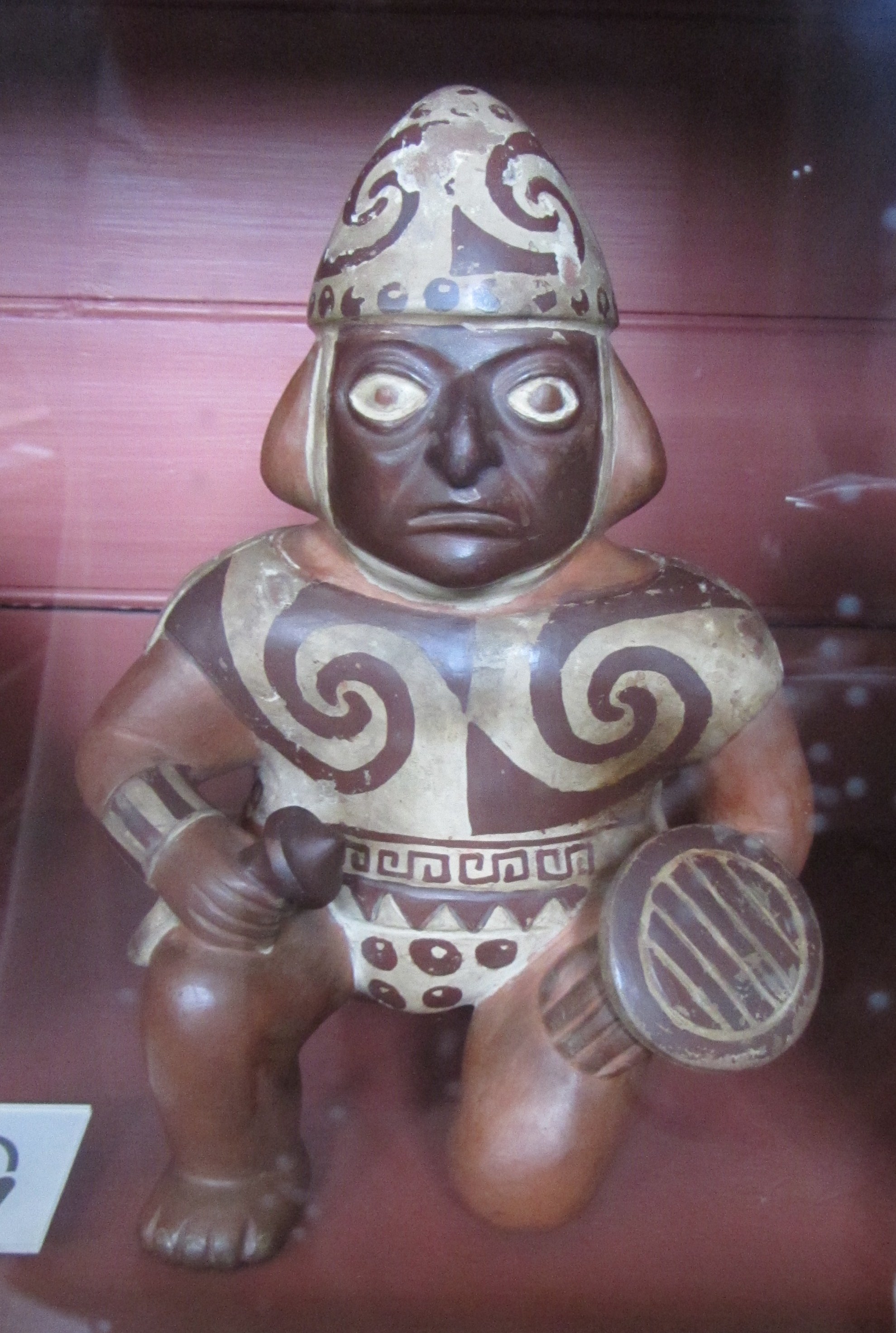
Shield List
A viewset for viewing and editing Shields.
GET /api/wf/shields/?format=api&page=6
{ "count": 374, "next": "https://seshat-db.com/api/wf/shields/?format=api&page=7", "previous": "https://seshat-db.com/api/wf/shields/?format=api&page=5", "results": [ { "id": 251, "polity": { "id": 443, "name": "mn_mongol_late", "long_name": "Late Mongols", "start_year": 1368, "end_year": 1690 }, "year_from": null, "year_to": null, "tag": "IFR", "is_disputed": false, "is_uncertain": false, "name": "Shield", "shield": "present", "comment": null, "description": " <i>The last Yuan emperor Toghon Temur returned to Mongolia and established the capital of his new Mongol state (\"which extended from Manchuria to Kyrgystan\") at Karakorum. At that time the MilTech codes would be the same as for the preceding Yuan China. Over the next decades the state lost territory and there was civil war at the start of the 15th century although in 1409 CE they still managed to rout a very large invading Ming army. The Ming attacked again but the Mongols were not conquered. Under an Oirat noble called Esen (1440-1455 CE) they invaded China in 1449 CE with 20,000 cavalry and captured the Ming emperor. In 1451 CE Esen overthrew the Mongol Khan but he wasn't a direct descendent of Genghis Khan and was killed during a 1455 CE rebellion. His rule was followed by minor Khans who ruled a Mongolia in which the Khalkhas were one of three 'left-flank' tumens (in addition to Chahars and Uriangqais). The state also had 'right-flank' tumens (Ordos, Tumeds, Yunshebus) and the Oirats of western Mongolia. \"These 6 tumens were major administrative units, often called ulus tumens (princedoms), comprising the 40 lesser tumens of the military-administrative type inherited from the Yuan period, each of which was reputedly composed of 10,000 cavalry troops ...\"§REF§(Ishjamts 2003, 208-211) N Ishjamts. 2003. The Mongols. Chahryar Adle. Irfan Habib. Karl M Baipakov. eds. History Of Civilizations Of Central Asia. Volume V. Development in contrast: from the sixteenth to the mid-nineteenth century. UNESCO Publishing. Paris.§REF§</i> The narrative suggests at least for 1400 CE and 1500 CE the army was cavalry based and in continuity with the preceding Yuan. The Yuan Dynasty is coded present for this armour." }, { "id": 252, "polity": { "id": 278, "name": "mn_rouran_khaganate", "long_name": "Rouran Khaganate", "start_year": 300, "end_year": 555 }, "year_from": null, "year_to": null, "tag": "IFR", "is_disputed": false, "is_uncertain": false, "name": "Shield", "shield": "present", "comment": null, "description": " \"Shields were known in all periods and, though they are mentioned in the contemporary literature, they only occasionally appear in artistic representations. They were typically made of leather on a reed frame, and a few rare examples survive.\" §REF§(Karasulas 2004, 29)§REF§" }, { "id": 253, "polity": { "id": 439, "name": "mn_shiwei", "long_name": "Shiwei", "start_year": 600, "end_year": 1000 }, "year_from": null, "year_to": null, "tag": "IFR", "is_disputed": false, "is_uncertain": false, "name": "Shield", "shield": "present", "comment": null, "description": " \"Shields were known in all periods and, though they are mentioned in the contemporary literature, they only occasionally appear in artistic representations. They were typically made of leather on a reed frame, and a few rare examples survive.\" §REF§(Karasulas 2004, 29)§REF§" }, { "id": 254, "polity": { "id": 440, "name": "mn_turk_khaganate_2", "long_name": "Second Turk Khaganate", "start_year": 682, "end_year": 744 }, "year_from": null, "year_to": null, "tag": "IFR", "is_disputed": false, "is_uncertain": false, "name": "Shield", "shield": "present", "comment": null, "description": " \"Shields were known in all periods and, though they are mentioned in the contemporary literature, they only occasionally appear in artistic representations. They were typically made of leather on a reed frame, and a few rare examples survive.\" §REF§(Karasulas 2004, 29)§REF§" }, { "id": 255, "polity": { "id": 286, "name": "mn_uygur_khaganate", "long_name": "Uigur Khaganate", "start_year": 745, "end_year": 840 }, "year_from": null, "year_to": null, "tag": "IFR", "is_disputed": false, "is_uncertain": false, "name": "Shield", "shield": "present", "comment": null, "description": " \"Shields were known in all periods and, though they are mentioned in the contemporary literature, they only occasionally appear in artistic representations. They were typically made of leather on a reed frame, and a few rare examples survive.\" §REF§(Karasulas 2004, 29)§REF§" }, { "id": 256, "polity": { "id": 438, "name": "mn_xianbei", "long_name": "Xianbei Confederation", "start_year": 100, "end_year": 250 }, "year_from": null, "year_to": null, "tag": "TRS", "is_disputed": false, "is_uncertain": false, "name": "Shield", "shield": "present", "comment": null, "description": " \"Shields were known in all periods and, though they are mentioned in the contemporary literature, they only occasionally appear in artistic representations. They were typically made of leather on a reed frame, and a few rare examples survive.\" §REF§(Karasulas 2004, 29)§REF§" }, { "id": 257, "polity": { "id": 437, "name": "mn_hunnu_early", "long_name": "Early Xiongnu", "start_year": -1400, "end_year": -300 }, "year_from": null, "year_to": null, "tag": "SSP", "is_disputed": false, "is_uncertain": false, "name": "Shield", "shield": "unknown", "comment": null, "description": null }, { "id": 258, "polity": { "id": 274, "name": "mn_hunnu_late", "long_name": "Late Xiongnu", "start_year": -60, "end_year": 100 }, "year_from": null, "year_to": null, "tag": "TRS", "is_disputed": false, "is_uncertain": false, "name": "Shield", "shield": "present", "comment": null, "description": " Wooden shields are mentioned by the Han. §REF§(Lewis 2000, 47)§REF§" }, { "id": 259, "polity": { "id": 272, "name": "mn_hunnu_emp", "long_name": "Xiongnu Imperial Confederation", "start_year": -209, "end_year": -60 }, "year_from": null, "year_to": null, "tag": "TRS", "is_disputed": false, "is_uncertain": false, "name": "Shield", "shield": "present", "comment": null, "description": " Wooden shields are mentioned by the Han. §REF§(Lewis 2000, 47)§REF§" }, { "id": 260, "polity": { "id": 444, "name": "mn_zungharian_emp", "long_name": "Zungharian Empire", "start_year": 1670, "end_year": 1757 }, "year_from": null, "year_to": null, "tag": "TRS", "is_disputed": false, "is_uncertain": false, "name": "Shield", "shield": "present", "comment": null, "description": " \"Because of their need of weaponry the Dzungar rulers opened iron, copper and silver mines and produced spears, shields, gunpowder, cannon, bullets and iron utensils.\" §REF§(Miyawaki et al 2003, 164)§REF§" }, { "id": 261, "polity": { "id": 224, "name": "mr_wagadu_3", "long_name": "Later Wagadu Empire", "start_year": 1078, "end_year": 1203 }, "year_from": null, "year_to": null, "tag": "TRS", "is_disputed": false, "is_uncertain": false, "name": "Shield", "shield": "present", "comment": null, "description": " \"Behind the king stand ten pages holding shields and swords decorated with gold...\" §REF§(Al-Bakri 1068 CE in Levtzion and Spaulding 2003, 16)§REF§" }, { "id": 262, "polity": { "id": 216, "name": "mr_wagadu_2", "long_name": "Middle Wagadu Empire", "start_year": 700, "end_year": 1077 }, "year_from": null, "year_to": null, "tag": "TRS", "is_disputed": false, "is_uncertain": false, "name": "Shield", "shield": "present", "comment": null, "description": " \"Behind the king stand ten pages holding shields and swords decorated with gold...\" §REF§(Al-Bakri 1068 CE in Levtzion and Spaulding 2003, 16)§REF§" }, { "id": 263, "polity": { "id": 525, "name": "mx_monte_alban_1_early", "long_name": "Early Monte Alban I", "start_year": -500, "end_year": -300 }, "year_from": null, "year_to": null, "tag": "SSP", "is_disputed": false, "is_uncertain": false, "name": "Shield", "shield": "unknown", "comment": null, "description": " Sources§REF§Marcus and Flannery (1996) Zapotec Civilization: How urban society evolved in Mexico’s Oaxaca Valley. Flannery and Marcus (1983) The Cloud People: divergent evolution of the Zapotec and Mixtec civilizations. Museum of Anthropology, University of Michigan, Ann Arbor. Academic Press, New York.§REF§ only mention very little archaeological evidence for military technology for this period, and this does not include armour. However, armour made from wood and cloth have been documented for the later periods, so their absence in the archaeological record may be due to preservation bias." }, { "id": 264, "polity": { "id": 526, "name": "mx_monte_alban_1_late", "long_name": "Monte Alban Late I", "start_year": -300, "end_year": -100 }, "year_from": null, "year_to": null, "tag": "SSP", "is_disputed": false, "is_uncertain": false, "name": "Shield", "shield": "unknown", "comment": null, "description": " Sources§REF§Marcus and Flannery (1996) Zapotec Civilization: How urban society evolved in Mexico’s Oaxaca Valley. Flannery and Marcus (1983) The Cloud People: divergent evolution of the Zapotec and Mixtec civilizations. Museum of Anthropology, University of Michigan, Ann Arbor. Academic Press, New York.§REF§ only mention very little archaeological evidence for military technology for this period, and this does not include armour. However, armour made from wood and cloth have been documented for the later periods, so their absence in the archaeological record may be due to preservation bias." }, { "id": 265, "polity": { "id": 527, "name": "mx_monte_alban_2", "long_name": "Monte Alban II", "start_year": -100, "end_year": 200 }, "year_from": null, "year_to": null, "tag": "SSP", "is_disputed": false, "is_uncertain": false, "name": "Shield", "shield": "unknown", "comment": null, "description": " Sources§REF§Marcus and Flannery (1996) Zapotec Civilization: How urban society evolved in Mexico’s Oaxaca Valley. Flannery and Marcus (1983) The Cloud People: divergent evolution of the Zapotec and Mixtec civilizations. Museum of Anthropology, University of Michigan, Ann Arbor. Academic Press, New York.§REF§ only mention very little archaeological evidence for military technology for this period, and this does not include armour. However, armour made from wood and cloth have been documented for the later periods, so their absence in the archaeological record may be due to preservation bias." }, { "id": 266, "polity": { "id": 528, "name": "mx_monte_alban_3_a", "long_name": "Monte Alban III", "start_year": 200, "end_year": 500 }, "year_from": null, "year_to": null, "tag": "SSP", "is_disputed": false, "is_uncertain": false, "name": "Shield", "shield": "unknown", "comment": null, "description": " Sources§REF§Marcus and Flannery (1996) Zapotec Civilization: How urban society evolved in Mexico’s Oaxaca Valley. Flannery and Marcus (1983) The Cloud People: divergent evolution of the Zapotec and Mixtec civilizations. Museum of Anthropology, University of Michigan, Ann Arbor. Academic Press, New York.§REF§ only mention very little archaeological evidence for military technology for this period, and this does not include armour. However, armour made from wood and cloth have been documented for the later periods, so their absence in the archaeological record may be due to preservation bias." }, { "id": 267, "polity": { "id": 529, "name": "mx_monte_alban_3_b_4", "long_name": "Monte Alban IIIB and IV", "start_year": 500, "end_year": 900 }, "year_from": null, "year_to": null, "tag": "SSP", "is_disputed": false, "is_uncertain": false, "name": "Shield", "shield": "unknown", "comment": null, "description": " Sources§REF§Marcus and Flannery (1996) Zapotec Civilization: How urban society evolved in Mexico’s Oaxaca Valley. Flannery and Marcus (1983) The Cloud People: divergent evolution of the Zapotec and Mixtec civilizations. Museum of Anthropology, University of Michigan, Ann Arbor. Academic Press, New York.§REF§ only mention very little archaeological evidence for military technology for this period, and this does not include armour. However, armour made from wood and cloth have been documented for the later periods, so their absence in the archaeological record may be due to preservation bias." }, { "id": 268, "polity": { "id": 532, "name": "mx_monte_alban_5", "long_name": "Monte Alban V", "start_year": 900, "end_year": 1520 }, "year_from": null, "year_to": null, "tag": "TRS", "is_disputed": false, "is_uncertain": false, "name": "Shield", "shield": "present", "comment": null, "description": " Written evidence from the Spanish written documents at the end of this period record the use of wooden or cane shields by military officers.§REF§Flannery and Marcus (1983) The Cloud People. New York. p217-8§REF§" }, { "id": 269, "polity": { "id": 6, "name": "mx_basin_of_mexico_1", "long_name": "Archaic Basin of Mexico", "start_year": -6000, "end_year": -2001 }, "year_from": null, "year_to": null, "tag": "IFR", "is_disputed": false, "is_uncertain": false, "name": "Shield", "shield": "absent", "comment": null, "description": " \"Little is known about warfare in Mesoamerica before the Middle Formative [...] warfare was relatively unorganized, conducted by small groups armed with unspecialized tool-weapons\".§REF§(Hassig 1992: 12-13) Seshat URL: <a class=\"external free\" href=\"https://www.zotero.org/groups/1051264/seshat_databank/items/itemKey/E9VHCKDG\" rel=\"nofollow\">https://www.zotero.org/groups/1051264/seshat_databank/items/itemKey/E9VHCKDG</a>.§REF§" }, { "id": 270, "polity": { "id": 16, "name": "mx_aztec_emp", "long_name": "Aztec Empire", "start_year": 1427, "end_year": 1526 }, "year_from": null, "year_to": null, "tag": "TRS", "is_disputed": false, "is_uncertain": false, "name": "Shield", "shield": "present", "comment": null, "description": " Listed by Hassig.§REF§(Hassig 1992: 139) Seshat URL: <a class=\"external free\" href=\"https://www.zotero.org/groups/1051264/seshat_databank/items/itemKey/E9VHCKDG\" rel=\"nofollow\">https://www.zotero.org/groups/1051264/seshat_databank/items/itemKey/E9VHCKDG</a>.§REF§" }, { "id": 271, "polity": { "id": 12, "name": "mx_basin_of_mexico_7", "long_name": "Classic Basin of Mexico", "start_year": 100, "end_year": 649 }, "year_from": null, "year_to": null, "tag": "TRS", "is_disputed": false, "is_uncertain": false, "name": "Shield", "shield": "present", "comment": null, "description": " \"Teotihuacan warriors therefore carried shields, but no other offensive weapons.\"§REF§(Hassig 1992: 47) Seshat URL: <a class=\"external free\" href=\"https://www.zotero.org/groups/1051264/seshat_databank/items/itemKey/E9VHCKDG\" rel=\"nofollow\">https://www.zotero.org/groups/1051264/seshat_databank/items/itemKey/E9VHCKDG</a>.§REF§" }, { "id": 272, "polity": { "id": 8, "name": "mx_basin_of_mexico_3", "long_name": "Early Formative Basin of Mexico", "start_year": -1200, "end_year": -801 }, "year_from": null, "year_to": null, "tag": "IFR", "is_disputed": false, "is_uncertain": false, "name": "Shield", "shield": "absent", "comment": null, "description": " \"Little is known about warfare in Mesoamerica before the Middle Formative [...] warfare was relatively unorganized, conducted by small groups armed with unspecialized tool-weapons\".§REF§(Hassig 1992: 12-13) Seshat URL: <a class=\"external free\" href=\"https://www.zotero.org/groups/1051264/seshat_databank/items/itemKey/E9VHCKDG\" rel=\"nofollow\">https://www.zotero.org/groups/1051264/seshat_databank/items/itemKey/E9VHCKDG</a>.§REF§" }, { "id": 273, "polity": { "id": 10, "name": "mx_basin_of_mexico_5", "long_name": "Late Formative Basin of Mexico", "start_year": -400, "end_year": -101 }, "year_from": null, "year_to": null, "tag": "TRS", "is_disputed": false, "is_uncertain": false, "name": "Shield", "shield": "present", "comment": null, "description": " \"In reaction to slings, shields were widely adopted in the Late Formative, especially rectangular ones that protected most of the body [...] The protection afforded the trunk and the limbs\".§REF§(Hassig 1992: 31) Seshat URL: <a class=\"external free\" href=\"https://www.zotero.org/groups/1051264/seshat_databank/items/itemKey/E9VHCKDG\" rel=\"nofollow\">https://www.zotero.org/groups/1051264/seshat_databank/items/itemKey/E9VHCKDG</a>.§REF§" }, { "id": 274, "polity": { "id": 9, "name": "mx_basin_of_mexico_4", "long_name": "Middle Formative Basin of Mexico", "start_year": -800, "end_year": -401 }, "year_from": null, "year_to": null, "tag": "IFR", "is_disputed": false, "is_uncertain": false, "name": "Shield", "shield": "absent", "comment": null, "description": " \"Little is known about warfare in Mesoamerica before the Middle Formative [...] warfare was relatively unorganized, conducted by small groups armed with unspecialized tool-weapons\".§REF§(Hassig 1992: 12-13) Seshat URL: <a class=\"external free\" href=\"https://www.zotero.org/groups/1051264/seshat_databank/items/itemKey/E9VHCKDG\" rel=\"nofollow\">https://www.zotero.org/groups/1051264/seshat_databank/items/itemKey/E9VHCKDG</a>.§REF§" }, { "id": 275, "polity": { "id": 11, "name": "mx_basin_of_mexico_6", "long_name": "Terminal Formative Basin of Mexico", "start_year": -100, "end_year": 99 }, "year_from": null, "year_to": null, "tag": "TRS", "is_disputed": false, "is_uncertain": false, "name": "Shield", "shield": "present", "comment": null, "description": " \"In reaction to slings, shields were widely adopted in the Late Formative, especially rectangular ones that protected most of the body [...] The protection afforded the trunk and the limbs\".§REF§(Hassig 1992: 31) Seshat URL: <a class=\"external free\" href=\"https://www.zotero.org/groups/1051264/seshat_databank/items/itemKey/E9VHCKDG\" rel=\"nofollow\">https://www.zotero.org/groups/1051264/seshat_databank/items/itemKey/E9VHCKDG</a>.§REF§" }, { "id": 276, "polity": { "id": 7, "name": "mx_basin_of_mexico_2", "long_name": "Initial Formative Basin of Mexico", "start_year": -2000, "end_year": -1201 }, "year_from": null, "year_to": null, "tag": "IFR", "is_disputed": false, "is_uncertain": false, "name": "Shield", "shield": "absent", "comment": null, "description": " \"Little is known about warfare in Mesoamerica before the Middle Formative [...] warfare was relatively unorganized, conducted by small groups armed with unspecialized tool-weapons\".§REF§(Hassig 1992: 12-13) Seshat URL: <a class=\"external free\" href=\"https://www.zotero.org/groups/1051264/seshat_databank/items/itemKey/E9VHCKDG\" rel=\"nofollow\">https://www.zotero.org/groups/1051264/seshat_databank/items/itemKey/E9VHCKDG</a>.§REF§" }, { "id": 277, "polity": { "id": 15, "name": "mx_basin_of_mexico_10", "long_name": "Middle Postclassic Basin of Mexico", "start_year": 1200, "end_year": 1426 }, "year_from": null, "year_to": null, "tag": "TRS", "is_disputed": false, "is_uncertain": false, "name": "Shield", "shield": "present", "comment": null, "description": " \"Most of the basic Mesoamerican armaments were in existence at this time [Classic period] - atlatls, darts, and spears, we well as clubs (bladed and unbladed), shields, cotton body armor, and unit standards [...] This military organization and technology was carried forward and elaborated on first by Toltecs and then by Aztecs\".§REF§(Hassig 1992: 5) Seshat URL: <a class=\"external free\" href=\"https://www.zotero.org/groups/1051264/seshat_databank/items/itemKey/E9VHCKDG\" rel=\"nofollow\">https://www.zotero.org/groups/1051264/seshat_databank/items/itemKey/E9VHCKDG</a>.§REF§" }, { "id": 278, "polity": { "id": 524, "name": "mx_rosario", "long_name": "Oaxaca - Rosario", "start_year": -700, "end_year": -500 }, "year_from": null, "year_to": null, "tag": "SSP", "is_disputed": false, "is_uncertain": false, "name": "Shield", "shield": "unknown", "comment": null, "description": " Sources§REF§Marcus and Flannery (1996) Zapotec Civilization: How urban society evolved in Mexico’s Oaxaca Valley. Flannery and Marcus (1983) The Cloud People: divergent evolution of the Zapotec and Mixtec civilizations. Museum of Anthropology, University of Michigan, Ann Arbor. Academic Press, New York.§REF§ only mention very little archaeological evidence for military technology for this period, and this does not include armour. However, armour made from wood and cloth have been documented for the later periods, so their absence in the archaeological record may be due to preservation bias." }, { "id": 279, "polity": { "id": 523, "name": "mx_san_jose", "long_name": "Oaxaca - San Jose", "start_year": -1150, "end_year": -700 }, "year_from": null, "year_to": null, "tag": "SSP", "is_disputed": false, "is_uncertain": false, "name": "Shield", "shield": "unknown", "comment": null, "description": " Relative to military technology used in this period, sources only mention the atlatl and spears.§REF§Marcus and Flannery (1996) Zapotec Civilization: How urban society evolved in Mexico’s Oaxaca Valley. Flannery and Marcus (1983) The Cloud People: divergent evolution of the Zapotec and Mixtec civilizations. Museum of Anthropology, University of Michigan, Ann Arbor. Academic Press, New York.§REF§ However, armour made from wood and cloth has been documented for the later periods, so its absence in the archaeological record may be due to preservation bias." }, { "id": 280, "polity": { "id": 522, "name": "mx_tierras_largas", "long_name": "Oaxaca - Tierras Largas", "start_year": -1400, "end_year": -1150 }, "year_from": null, "year_to": null, "tag": "SSP", "is_disputed": false, "is_uncertain": false, "name": "Shield", "shield": "unknown", "comment": null, "description": " Relative to military technology used in this period, sources only mention the atlatl and spears.§REF§Marcus and Flannery (1996) Zapotec Civilization: How urban society evolved in Mexico’s Oaxaca Valley. Flannery and Marcus (1983) The Cloud People: divergent evolution of the Zapotec and Mixtec civilizations. Museum of Anthropology, University of Michigan, Ann Arbor. Academic Press, New York.§REF§ However, armour made from wood and cloth has been documented for the later periods, so its absence in the archaeological record may be due to preservation bias." }, { "id": 281, "polity": { "id": 14, "name": "mx_toltec", "long_name": "Toltecs", "start_year": 900, "end_year": 1199 }, "year_from": null, "year_to": null, "tag": "TRS", "is_disputed": false, "is_uncertain": false, "name": "Shield", "shield": "present", "comment": null, "description": " \"Toltecs [were] bearing spearthrowers and back shields\".§REF§(Evans 2004: 402) Seshat URL: <a class=\"external free\" href=\"https://www.zotero.org/groups/1051264/seshat_databank/items/itemKey/EWW3Q2TA\" rel=\"nofollow\">https://www.zotero.org/groups/1051264/seshat_databank/items/itemKey/EWW3Q2TA</a>.§REF§" }, { "id": 282, "polity": { "id": 116, "name": "no_norway_k_2", "long_name": "Kingdom of Norway II", "start_year": 1262, "end_year": 1396 }, "year_from": null, "year_to": null, "tag": "TRS", "is_disputed": false, "is_uncertain": false, "name": "Shield", "shield": "present", "comment": null, "description": "§REF§Júlíusson and Kristissen, pers. comm. 2017§REF§" }, { "id": 283, "polity": { "id": 78, "name": "pe_cuzco_2", "long_name": "Cuzco - Early Intermediate I", "start_year": 200, "end_year": 499 }, "year_from": null, "year_to": null, "tag": "TRS", "is_disputed": false, "is_uncertain": false, "name": "Shield", "shield": "unknown", "comment": null, "description": " §REF§(Brian Bauer 2015, personal communication)§REF§" }, { "id": 284, "polity": { "id": 79, "name": "pe_cuzco_3", "long_name": "Cuzco - Early Intermediate II", "start_year": 500, "end_year": 649 }, "year_from": null, "year_to": null, "tag": "TRS", "is_disputed": false, "is_uncertain": false, "name": "Shield", "shield": "unknown", "comment": null, "description": " The Peruvian Moche civilization (end c700 CE) had small round shields attached to forearm, as demonstrated by the Moche warrior pot in the British Museum. §REF§(British Museum. Link to photo: <a class=\"external free\" href=\"https://upload.wikimedia.org/wikipedia/commons/a/a3/Moche_warrior_pot_at_the_British_Museum.jpg\" rel=\"nofollow\">https://upload.wikimedia.org/wikipedia/commons/a/a3/Moche_warrior_pot_at_the_British_Museum.jpg</a>)§REF§ <span style=\"color:blue\">Not the same archaeological sub-tradition</span>" }, { "id": 285, "polity": { "id": 81, "name": "pe_cuzco_5", "long_name": "Cuzco - Late Intermediate I", "start_year": 1000, "end_year": 1250 }, "year_from": null, "year_to": null, "tag": "SSP", "is_disputed": false, "is_uncertain": false, "name": "Shield", "shield": "unknown", "comment": null, "description": null }, { "id": 286, "polity": { "id": 82, "name": "pe_cuzco_6", "long_name": "Cuzco - Late Intermediate II", "start_year": 1250, "end_year": 1400 }, "year_from": null, "year_to": null, "tag": "SSP", "is_disputed": false, "is_uncertain": false, "name": "Shield", "shield": "unknown", "comment": null, "description": null }, { "id": 287, "polity": { "id": 77, "name": "pe_cuzco_1", "long_name": "Cuzco - Late Formative", "start_year": -500, "end_year": 200 }, "year_from": null, "year_to": null, "tag": "SSP", "is_disputed": false, "is_uncertain": false, "name": "Shield", "shield": "unknown", "comment": null, "description": null }, { "id": 288, "polity": { "id": 83, "name": "pe_inca_emp", "long_name": "Inca Empire", "start_year": 1375, "end_year": 1532 }, "year_from": null, "year_to": null, "tag": "TRS", "is_disputed": false, "is_uncertain": false, "name": "Shield", "shield": "present", "comment": null, "description": " Oval shields made of leather. §REF§(Bauer 2004, 96)§REF§" }, { "id": 289, "polity": { "id": 80, "name": "pe_wari_emp", "long_name": "Wari Empire", "start_year": 650, "end_year": 999 }, "year_from": null, "year_to": null, "tag": "TRS", "is_disputed": false, "is_uncertain": false, "name": "Shield", "shield": "present", "comment": null, "description": " If we use warrior figurines from Pikillacta as evidence: large rectangular shield (wooden?); spear-thrower; helmet (presumably bronze?). §REF§(Bergh in Bergh 2012, 237)§REF§" }, { "id": 290, "polity": { "id": 445, "name": "pg_orokaiva_pre_colonial", "long_name": "Orokaiva - Pre-Colonial", "start_year": 1734, "end_year": 1883 }, "year_from": null, "year_to": null, "tag": "TRS", "is_disputed": false, "is_uncertain": false, "name": "Shield", "shield": "present", "comment": null, "description": " Warriors protected their bodies with wooden shields: 'The Shield. The shield (beha or pere) is made of light wood, about ½ inch thick, strongly bound with narrow strips of cane to prevent splitting. The handle is a loop of stout rattan which passes through the wood. The shape of the shield-square cut above and pointed below-caused early observers to refer to it very appropriately as ‘Gothic’. It sometimes bears a device-in no manner heraldic but purely decorative-made by interlacing black strands among the yellow cane binding strips; and when this is well done the effect may be artistic and even dainty (Plate XIX)... Shields are used very adroitly in turning or intercepting missiles, and a broken spear-point buried in the wood is regarded as a trophy. Despite the fact that their serious use is over they are still very commonly kept in readiness-at least by the Aiga-and they always make a fracas possible. Like most other men the Orokaiva has no stomach for the plain spear, and he enjoys his inter-tribal brawl much more when he has a beha in his hand.' §REF§Williams, F. E. (Francis Edgar), and Hubert Murray. 1930. “Orokaiva Society.”, 84§REF§" }, { "id": 291, "polity": { "id": 446, "name": "pg_orokaiva_colonial", "long_name": "Orokaiva - Colonial", "start_year": 1884, "end_year": 1942 }, "year_from": null, "year_to": null, "tag": "TRS", "is_disputed": false, "is_uncertain": false, "name": "Shield", "shield": "present", "comment": null, "description": " The Shield. The shield (beha or pere) is made of light wood, about ½ inch thick, strongly bound with narrow strips of cane to prevent splitting. The handle is a loop of stout rattan which passes through the wood. The shape of the shield-square cut above and pointed below-caused early observers to refer to it very appropriately as ‘Gothic’. It sometimes bears a device-in no manner heraldic but purely decorative-made by interlacing black strands among the yellow cane binding strips; and when this is well done the effect may be artistic and even dainty (Plate XIX)... Shields are used very adroitly in turning or intercepting missiles, and a broken spear-point buried in the wood is regarded as a trophy. Despite the fact that their serious use is over they are still very commonly kept in readiness-at least by the Aiga-and they always make a fracas possible. Like most other men the Orokaiva has no stomach for the plain spear, and he enjoys his inter-tribal brawl much more when he has a beha in his hand.§REF§Williams, F. E. (Francis Edgar), and Hubert Murray. 1930. “Orokaiva Society.”, 84§REF§" }, { "id": 292, "polity": { "id": 117, "name": "pk_kachi_enl", "long_name": "Kachi Plain - Aceramic Neolithic", "start_year": -7500, "end_year": -5500 }, "year_from": null, "year_to": null, "tag": "TRS", "is_disputed": false, "is_uncertain": false, "name": "Shield", "shield": "absent", "comment": null, "description": "Only flint, bone and copper tools tools have been found at Mehrgarh §REF§Petrie, C. A. (in press) Chapter 11, Case Study: Mehrgarh. In, Barker, G and Goucher, C (eds.) Cambridge World History, Volume 2: A World with Agriculture, 12,000 BCE - 500 CE. Cambridge University Press: Cambridge§REF§" }, { "id": 293, "polity": { "id": 118, "name": "pk_kachi_lnl", "long_name": "Kachi Plain - Ceramic Neolithic", "start_year": -5500, "end_year": -4000 }, "year_from": null, "year_to": null, "tag": "TRS", "is_disputed": false, "is_uncertain": false, "name": "Shield", "shield": "absent", "comment": null, "description": "Only flint, bone and copper tools tools have been found at Mehrgarh §REF§Petrie, C. A. (in press) Chapter 11, Case Study: Mehrgarh. In, Barker, G and Goucher, C (eds.) Cambridge World History, Volume 2: A World with Agriculture, 12,000 BCE - 500 CE. Cambridge University Press: Cambridge§REF§" }, { "id": 294, "polity": { "id": 119, "name": "pk_kachi_ca", "long_name": "Kachi Plain - Chalcolithic", "start_year": -4000, "end_year": -3200 }, "year_from": null, "year_to": null, "tag": "TRS", "is_disputed": false, "is_uncertain": false, "name": "Shield", "shield": "absent", "comment": null, "description": "Only flint, bone and copper tools tools have been found at Mehrgarh §REF§Petrie, C. A. (in press) Chapter 11, Case Study: Mehrgarh. In, Barker, G and Goucher, C (eds.) Cambridge World History, Volume 2: A World with Agriculture, 12,000 BCE - 500 CE. Cambridge University Press: Cambridge§REF§" }, { "id": 295, "polity": { "id": 126, "name": "pk_indo_greek_k", "long_name": "Indo-Greek Kingdom", "start_year": -180, "end_year": -10 }, "year_from": null, "year_to": null, "tag": "IFR", "is_disputed": false, "is_uncertain": false, "name": "Shield", "shield": "present", "comment": null, "description": "Shields used by Greek soldiers. §REF§Sekunda, Nick, and Nicholas Sekunda. The Ancient Greeks. Vol. 7. Osprey Publishing Company, 1986.§REF§ Yuezhi (Kushan) find at Tillya-Tepe: \"decorative gold clasp depicted a Greek infantryman in a cuirass breastplate carrying a spear and an oval shield.\"§REF§(McLaughlin 2016, 78) Raoul McLaughlin. 2016. The Roman Empire and the Silk Routes: The Ancient World Economy and the Empires of Parthia, Central Asia and Han China. Pen and Sword History. Barnsley.§REF§" }, { "id": 296, "polity": { "id": 123, "name": "pk_kachi_post_urban", "long_name": "Kachi Plain - Post-Urban Period", "start_year": -1800, "end_year": -1300 }, "year_from": null, "year_to": null, "tag": "TRS", "is_disputed": false, "is_uncertain": false, "name": "Shield", "shield": "absent", "comment": null, "description": "No evidence for weapons or armor, apart from arrowheads, spearheads, daggers and axes, have been found at Pirak. This may in part be due to preservation conditions at the site. §REF§Jarrige, J-F. (1979) Fouilles de Pirak. Paris : Diffusion de Boccard.§REF§" }, { "id": 297, "polity": { "id": 120, "name": "pk_kachi_pre_urban", "long_name": "Kachi Plain - Pre-Urban Period", "start_year": -3200, "end_year": -2500 }, "year_from": null, "year_to": null, "tag": "TRS", "is_disputed": false, "is_uncertain": false, "name": "Shield", "shield": "absent", "comment": null, "description": null }, { "id": 298, "polity": { "id": 124, "name": "pk_kachi_proto_historic", "long_name": "Kachi Plain - Proto-Historic Period", "start_year": -1300, "end_year": -500 }, "year_from": null, "year_to": null, "tag": "SSP", "is_disputed": false, "is_uncertain": false, "name": "Shield", "shield": "unknown", "comment": null, "description": " If \"the first archaeologically recognizable, large post-Indus urban settlements are not earlier than the fifth century BC ... solidly visible states ... appear in a sudden profusion in the late first millennium B.C.\"§REF§(Ahmed 2014, 64) Mukhtar Ahmed. 2014. Ancient Pakistan - An Archaeological History: Volume V: The End of the Harappan Civilization, and the Aftermath. Foursome Group.§REF§ - who was king Stabrobates of India who used war elephants against a queen of Assyria (considered Shammuramat?) in the 9th century BCE?§REF§(Mayor 2014, 289) Adrienne Mayor. Animals in Warfare. Gordon Lindsay Campbell. ed. 2014. The Oxford Handbook of Animals in Classical Thought and Life. Oxford University Press. Oxford.§REF§ One could infer king Stabrobates, if not based there himself, must have subdued and controlled the Kachi Plain region in order to invade Mesopotamia from 'India'. (Another source says Assyria invaded India and were driven out of Pakistan and India).§REF§(Kistler 2007, 18) John M Kistler. 2007. War Elephants. University of Nebraska Press. Lincoln.§REF§ Diodorus Siculus says this too, queen Semiramis was based in Bactra (Bactria?).§REF§Diodorus Siculus. Delphi Complete Works of Diodorus Siculus. Delphi Classics.§REF§ <i>If king Stabrobates's polity controlled the Kachi Plain then we must code the according to the military technology he possessed. This would have included armour. Note: one military historian estimates that the Assyrian army had a strategic range of 2000 km§REF§(Gabriel 2002, 9) Richard A Gabriel. 2002. The Great Armies of Antiquity. Praeger. Westport.§REF§ which places the Indus region in reach of their forces.</i>" }, { "id": 299, "polity": { "id": 133, "name": "pk_sind_abbasid_fatimid", "long_name": "Sind - Abbasid-Fatimid Period", "start_year": 854, "end_year": 1193 }, "year_from": null, "year_to": null, "tag": "TRS", "is_disputed": false, "is_uncertain": false, "name": "Shield", "shield": "present", "comment": null, "description": " Widely available for soldiers. §REF§Kennedy, the Armies of the Caliphs pp. 168-178§REF§ According to the Cach-nama \"the common weapons of the Indian soldiers in early medieval India were 'swords, shields, javelins, spears, and daggers.' Other sources indicate that they also carried lances, maces and lassos.\"§REF§(Eraly 2015) Abraham Eraly. 2015. The Age of Wrath: A History of the Delhi Sultanate. Penguin.§REF§" }, { "id": 300, "polity": { "id": 136, "name": "pk_samma_dyn", "long_name": "Sind - Samma Dynasty", "start_year": 1335, "end_year": 1521 }, "year_from": null, "year_to": null, "tag": "TRS", "is_disputed": false, "is_uncertain": false, "name": "Shield", "shield": "present", "comment": null, "description": " Inferred, widely available for soldiers in the region. §REF§Kennedy, the Armies of the Caliphs pp. 168-178§REF§" } ] }